
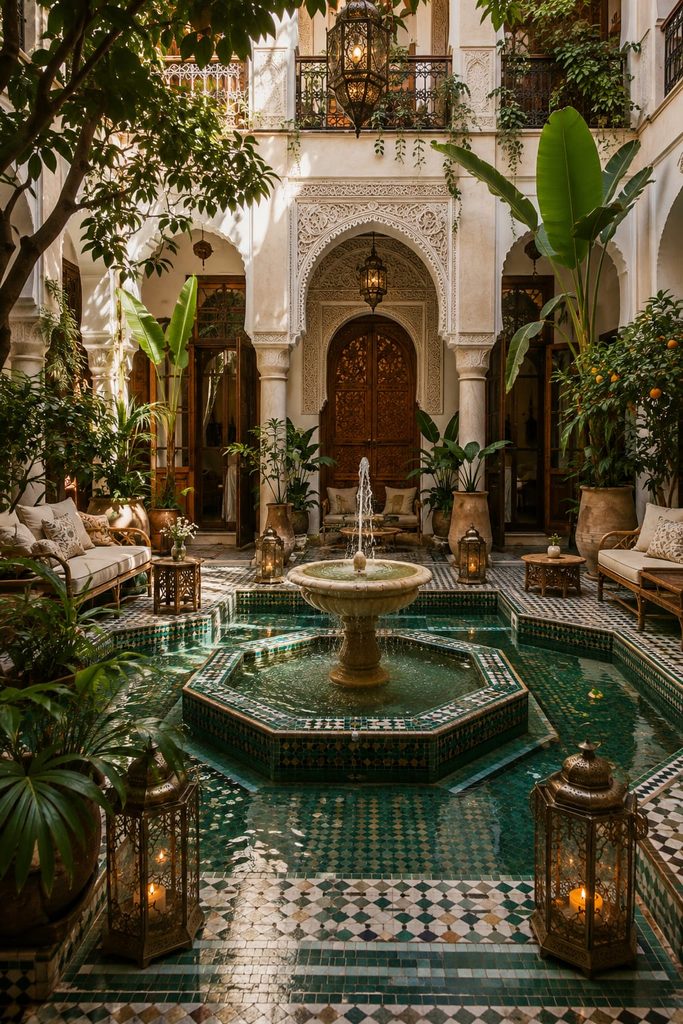
There is something deeply captivating about walking through the doors of Moroccan riad.
From the outside, it may appear modestm, sometimes almost hidden among the narrow streets of the medina. But once the door opens, another world reveals itself: a peaceful courtyard, the sound of a fountain, intricate zellige tiles, carved wood, soft light, and the scent of orange blossom or traditional Moroccan tea.
This contrast is part of what makes the riad so special.
A Moroccan riad is not simply a place to stay. It is an architectural expression of privacy, family, craftsmanship, nature, and hospitality. Today, riads have become one of Morocco’s most recognizable forms of boutique accommodation, attracting travelers looking for something more personal and authentic than a conventional hotel.
But behind their beautiful courtyards and traditional details lies a much deeper story.
What Is a Moroccan Riad?
The word riad, often written ryad or riad, comes from the Arabic word riyad, meaning gardens.
Traditionally, a riad is a house organized around an interior courtyard or garden. Instead of opening extensively toward the street, the home turns inward.
This architectural concept reflects an important principle in traditional Moroccan life: privacy.
The exterior of a traditional riad can be relatively simple, while the interior can be remarkably rich. Once inside, residents and guests discover a private environment designed around the central courtyard.
This inward-facing architecture creates a unique atmosphere protected from the noise of the street and connected to light, water, greenery, and open air.
The result is a home that feels intimate, peaceful, and surprisingly spacious.
The Courtyard: The Heart of the Riad
At the center of almost every traditional riad is its courtyard.
This is more than an architectural feature. It is the heart of the house.
The courtyard traditionally provided light and ventilation while creating a shared space for everyday life. Plants, trees, fountains, and shaded areas could transform the center of the home into a small private garden.
Water often plays an important role as well.
A fountain or small pool can introduce movement and sound into the space, creating a feeling of calm. In a country where water has always carried practical and symbolic importance, its presence within architecture adds another layer of meaning.
For today’s traveler, this courtyard creates one of the most memorable characteristics of a riad: the feeling of discovering an oasis behind an otherwise discreet entrance.
A Reflection of Moroccan Craftsmanship
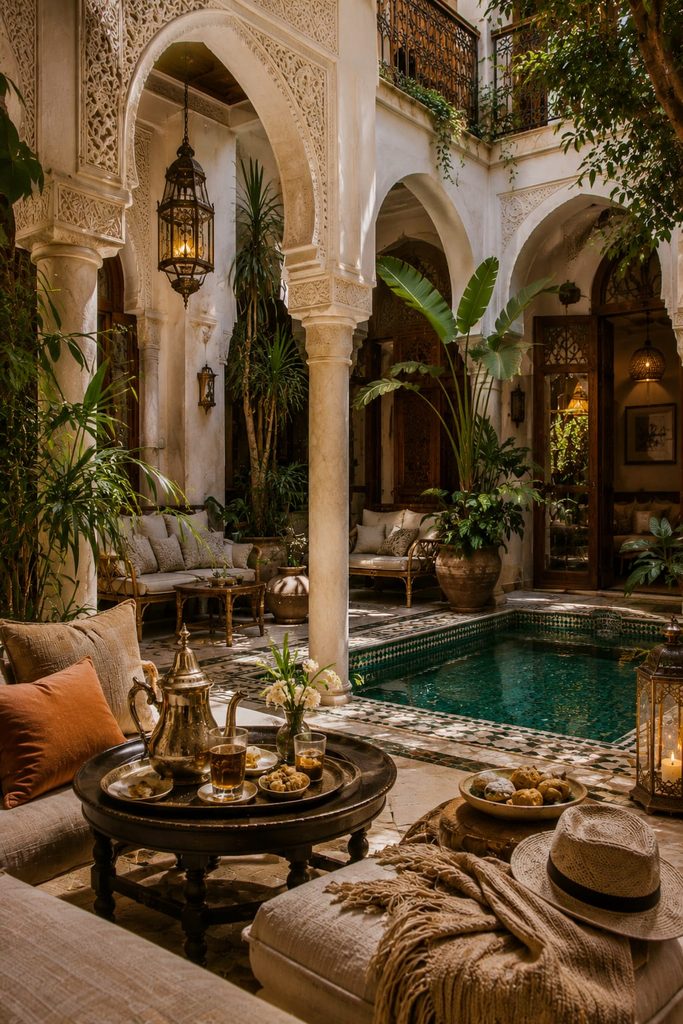
One of the reasons riads remain so visually powerful is the extraordinary craftsmanship found throughout their interiors.
Traditional Moroccan architecture brings together several artistic disciplines.
Zellige, the famous geometric mosaic tilework, can cover walls, fountains, floors, and columns with intricate patterns.
Tadelakt, a polished lime-based plaster traditionally used in Morocco, gives walls and surfaces their distinctive smooth appearance.
Carved cedar wood, painted ceilings, wrought iron, brass details, woven textiles, and traditional Moroccan carpets can all contribute to the character of a riad.
These details were not originally created simply for decoration.
They reflected generations of craftsmanship passed from one artisan to another.
Every geometric pattern, carved surface, tile, and handmade object can tell part of Morocco’s cultural story.
Why Riads Look Inward
One of the most fascinating aspects of riad architecture is its relationship with the street.
A traditional Moroccan house does not necessarily announce itself from the outside.
Instead, the experience begins when you enter.
This inward-facing design has historical and cultural roots. It helped protect family life from the outside world while creating a private environment within the home.
The concept is almost the opposite of many modern buildings, where large windows and open façades are designed to connect interiors with the street.
In a riad, the connection is reversed.
The outside becomes discreet, while the inside becomes the experience.
This principle is one reason riads feel so different from conventional hotels.
Moroccan Art of Hospitality
Hospitality is deeply embedded in Moroccan culture, and the traditional riad was naturally designed around social life.
The courtyard could become a place for conversation, meals, family gatherings, and moments of relaxation.
Guests were welcomed into the private world of the home rather than simply given a room.
This distinction remains relevant today.
When travelers stay in a Moroccan riad, they often experience something that feels more intimate than conventional accommodation. Breakfast may be served in the courtyard. Moroccan tea may arrive on a traditional silver tray. Staff may recommend a neighborhood restaurant, a hidden souk, or a local artisan.
The property becomes part of the experience.
And hospitality becomes more than a service, it becomes a relationship.
From Traditional Homes to Boutique Hotels
Over time, many historic riads in Moroccan medinas have been restored and transformed into boutique guesthouses.
This transformation presents both an opportunity and a responsibility.
The opportunity is to give travelers access to authentic Moroccan architecture and hospitality.
The responsibility is to preserve the character of the original building.
Successful riad restoration is therefore not simply about making an old property look beautiful.
It is about understanding what makes the building special in the first place.
The proportions of the courtyard, the traditional materials, the craftsmanship, the relationship between rooms, and the sense of privacy all contribute to the identity of the property.
Modern comforts can be introduced high-quality beds, contemporary bathrooms, air conditioning, Wi-Fi, wellness facilities, and personalized services without erasing the character that makes the riad unique.
The New Meaning of Luxury
For modern travelers, luxury is increasingly about more than expensive furniture or large rooms.
It can mean privacy.
authenticity.
waking up in a historic building, enjoying breakfast beneath an open sky, listening to the sound of water in a courtyard, or drinking Moroccan tea surrounded by handmade craftsmanship.
This is where the riad fits perfectly into the evolution of boutique hospitality.
A riad offers something that is difficult to reproduce in a standardized hotel:
a sense of place.
Every property has its own architecture, history, atmosphere, neighborhood, and story.
The imperfections can even become part of the charm.
An old doorway, handmade tiles, traditional plaster, or centuries-old architectural proportions can create an experience that feels impossible to duplicate.
Riads as Living Pieces of Moroccan Heritage
There is another important dimension to riads: heritage preservation.
Historic medinas across Morocco contain architectural traditions that have developed over generations.
Boutique hospitality can therefore play a role in preserving architectural heritage.
Instead of allowing historic buildings to disappear or lose their original character, thoughtful restoration can give them a new purpose.
The building continues to live.
Its courtyard continues to welcome people.
Why Travelers Fall in Love With Riads
Perhaps the real magic of a riad comes from the contrast between what travelers expect and what they discover.
- They may enter through a small, unassuming door in the middle of a busy medina.
- Then everything changes.
- The noise fades.
- The courtyard opens.
- Light enters from above.
- Water moves quietly through a fountain.
- The walls reveal patterns created by artisans.
- A cup of Moroccan tea arrives.
- And suddenly, the traveler is no longer simply visiting Morocco.
- They are experiencing it.
- That emotional transition is one of the strongest qualities of riad hospitality.
The Riad as an Experience, Not Just Accommodation
The most successful boutique riads understand that their greatest asset is not simply the number of rooms they offer.
- It is the story they tell.
- Architecture tells one part of that story.
- Food tells another.
- Design, service, local experiences, craftsmanship, wellness, and human connection add the rest.
- This is why the modern riad can become much more than accommodation.
- It can become a gateway into Moroccan culture.
- A place where travelers can slow down, discover local traditions, appreciate craftsmanship, and experience hospitality in a more personal way.
The Story Continues
Today, these historic homes are finding new life as boutique hotels and intimate hospitality experiences. Their courtyards are welcoming travelers from around the world, while their architecture continues to preserve ideas that have shaped Moroccan homes for generations.
The challenge for modern hospitality is to evolve without losing authenticity.
To introduce comfort without removing character.
To modernize without erasing history.
And to create memorable experiences while respecting the story of the place.
At Locanda Boutique Collection, this philosophy is at the heart of boutique hospitality: creating stays that connect guests with the character, culture, and spirit of Morocco.